Vision Inspection System: How Camera-Based Inspection Works
Modern manufacturing lines need to inspect products quickly and consistently while maintaining production speed. Manual inspection can become challenging when thousands of products or packages need to be checked during a production shift.
A Vision Inspection System uses industrial cameras, controlled lighting, image-processing software, and inspection algorithms to automatically examine products and packaging. Depending on the application, it can detect defects, verify product presence, inspect labels, read printed information, and check barcodes or DataMatrix codes.
With the integration of AI and machine learning, modern systems can also handle complex visual inspection tasks that may be difficult to manage using traditional inspection methods.
What Is a Vision Inspection System?
A vision inspection system is an automated quality-control solution that captures images of products and analyzes them against predefined inspection criteria.A typical system includes:
- Industrial cameras
- Lenses
- Controlled lighting
- Image-processing software
- AI or machine-learning technology
- PLC communication
- HMI/operator interface
- Automatic rejection mechanisms
The camera captures an image as the product moves through the inspection area. Software then analyzes the image to determine whether the product meets the required quality standards.This makes automated vision inspection useful for repetitive, high-speed manufacturing processes where consistent inspection is important.
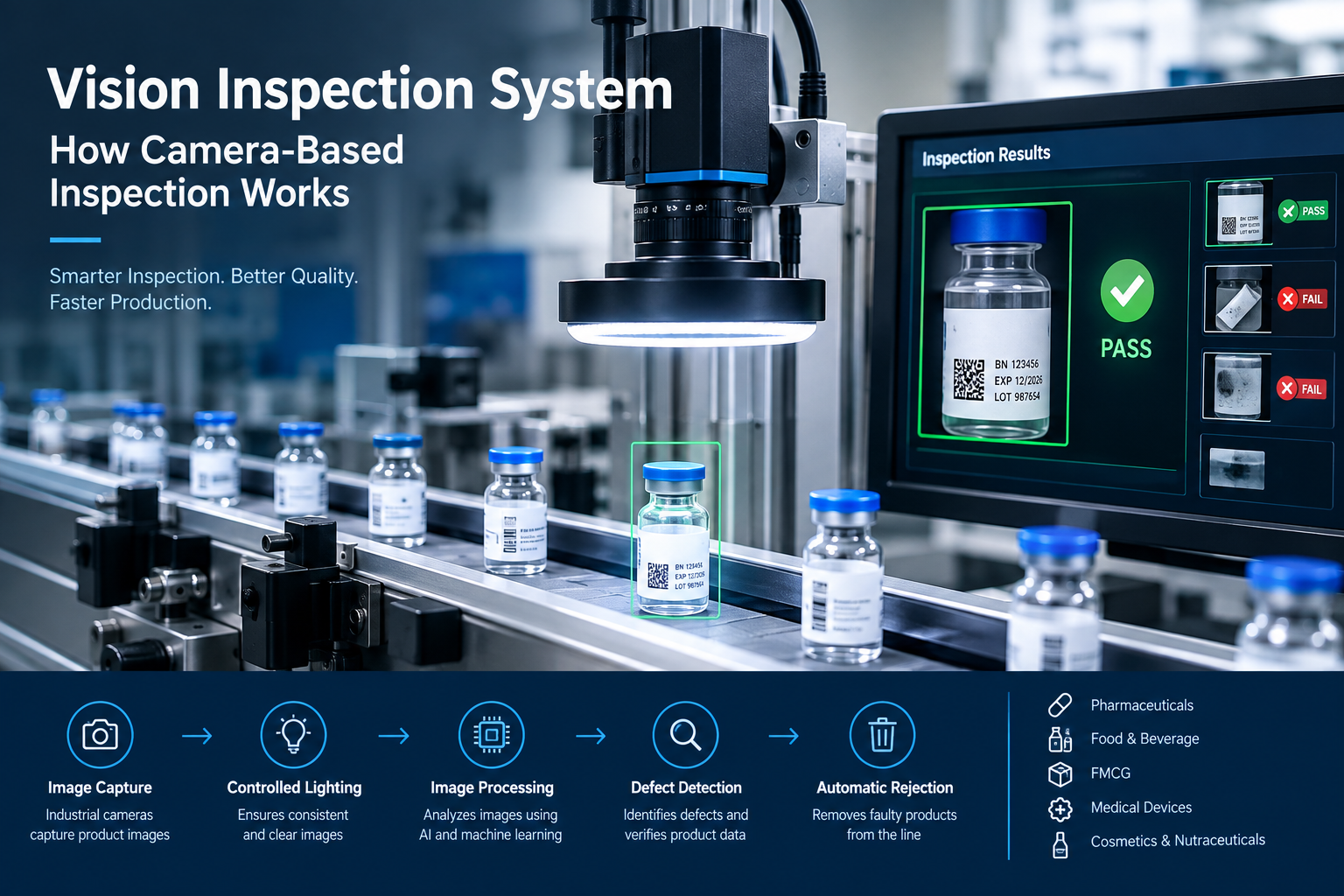
How Does Vision System Camera Inspection Work?
A vision system camera inspection process generally involves several connected steps.
1. Image Capture
An industrial camera captures images of products as they move through the production line. Camera selection depends on factors such as production speed, product size, field of view, and the smallest defect that needs to be detected.
2. Controlled Lighting
Lighting plays an important role in creating consistent inspection images. The right lighting can highlight scratches, cracks, surface defects, labels, printed information, edges, and other product characteristics.
3. Image Processing
The captured image is processed by inspection software. Depending on the application, the system can analyze shape, size, color, position, surface appearance, text, barcodes, DataMatrix codes, and product presence.
4. Defect Detection
The software compares the captured image with predefined inspection criteria. Products that meet the requirements can be classified as pass, while products with detected defects can be classified as fail.
5. Automatic Rejection
The inspection result can be communicated to the production equipment. A rejection mechanism can then remove defective products from the production line.
What Can a Vision Inspection System Detect?
A machine vision inspection system can be configured for different inspection requirements.Common applications include:
- Missing or damaged products
- Shape and size variations
- Surface and cosmetic defects
- Contamination
- Missing components
- Incorrect labels
- Label position
- Packaging defects
- Batch and expiry information
- Barcode and DataMatrix verification
- OCR and OCV inspection
The exact inspection capability depends on the product, camera configuration, lighting, software, and inspection criteria.
AI Vision Inspection vs Traditional Inspection
Traditional vision inspection generally uses predefined rules, thresholds, patterns, and measurements to identify specific characteristics.
An AI vision inspection system can use machine learning or deep learning to recognize more complex visual variations. This can be useful when defects are difficult to describe using fixed rules or when products have natural appearance variations.
AI can be considered for applications involving:
- Complex cosmetic defects
- Variable product appearance
- Difficult-to-define defects
- Advanced anomaly detection
- Large image datasets
The right technology should be selected according to the actual inspection challenge rather than assuming AI is required for every application.
Vision Inspection for Pharmaceutical Manufacturing
Pharmaceutical manufacturing is an important application for automated vision inspection. Products and packaging may require multiple checks before they move to the next stage of production.
A pharmaceutical vision inspection system can support inspection of:
- Tablets
- Capsules
- Blisters
- Vials
- Bottles
- Labels
- Cartons
- Printed codes
Packaging inspection may include product presence, label verification, barcode inspection, DataMatrix verification, OCR, OCV, and other visual checks.
Jekson Vision provides vision inspection solutions for pharmaceutical and other manufacturing applications, including product, packaging, and code inspection.
Benefits of Automated Vision Inspection
A camera-based inspection system can support manufacturers in several areas:
Consistent inspection: Configured inspection criteria can be applied repeatedly across production.
Automated quality control: Products can be inspected automatically as they move through the production line.
High-speed inspection: Vision systems can be integrated into automated production environments.
Real-time defect detection: Defective products can be identified during production.
Digital inspection data: Depending on the system configuration, inspection results can be recorded for analysis and reporting.
Production-line integration: Vision systems can communicate with PLCs, conveyors, packaging machines, and rejection systems.
How to Choose the Right Vision Inspection System
Selecting the right industrial vision inspection system requires evaluating the complete application.Consider:
- What defects need to be detected?
- What is the production-line speed?
- What is the smallest feature or defect?
- What camera resolution is required?
- What lighting arrangement is suitable?
- Is AI or traditional image processing more appropriate?
- Does the system need PLC or machine integration?
- Are data, validation, or regulatory requirements applicable?
A proper application assessment can help determine the right camera, lens, lighting, software, and inspection configuration.
Conclusion
A vision inspection system combines cameras, lighting, image processing, and inspection software to automate visual quality checks across manufacturing processes.
From pharmaceutical tablets and blister packs to vials, bottles, labels, cartons, and printed codes, vision inspection can support automated defect detection and product verification.
The effectiveness of a vision system camera inspection setup depends on more than the camera itself. Product presentation, lighting, image quality, software, inspection criteria, and production-line integration all need to work together.
If you are evaluating an automated vision inspection solution for your production line, Jekson Vision can help assess your inspection requirements and identify a suitable approach.
Explore Jekson Vision's Vision Inspection Systems to learn how camera-based and AI-driven inspection solutions can support automated quality control.
